
| Abstract This paper calculates the tax liability of the new NSW Residential Land Tax in 'net present value' terms. This gives a much clearer representation of 'effective' tax rates for land both above and below the threshold. For instance, if real land values grow at just 2% (well below historical precedent), we find that the actual tax liability can easily consume over 50% of present land value. At higher growth rates, the tax liability is more severe. The long term impact of the NSW Land Tax thus represents a significant transition of wealth from the private sector to the state, not only for property above the threshold, but quite generally also for property below the threshold. |
Section II calculates the tax liability. Section III provides examples. Section IV assesses the impact on the market value of land. Section V concludes.
Figure 1: Average Tax Rates for different land values

Let:
| vt = assessed land value (ALV) at time t | gv = the rate of growth of v |
| ct = ceiling at time t | gc = the rate of growth of c |
| r = discount rate | h = tax rate (1.85%) |
If v0 denotes the current ALV, while c0 denotes the current ceiling ($1million), the tax liability payable during time t is:
[1]  where
where 
Then the net present value of the tax stream is:
[2] 
A. Convergence
If  , this sum converges to a closed-form expression. There are two possible cases, (i) and (ii):
(i) If  , then:
[3] 
which is a simple linear function of assessed land values (v0).
(ii) If  , the property's ALV is below the ceiling and so it will not accrue taxes in the first few periods. However, if gv > gc it is only a matter of time until every property eventually attracts a tax liability. Let n denote the time period in which the first tax payment will be required. Then given n, the net present value of the tax liability can still be expressed as a closed-form solution, as follows:
[4] 
B. Non-convergence
If  , the sum does not converge. Nevertheless, the present value after finite T periods can still be calculated as:
[5] 
This will rapidly explode, sending the tax liability to infinity. While the rate of growth on land values has exceeded the discount rate in recent years, this behaviour is not sustainable in the long-run.
| Example 1: | Land values grow at 2% p.a. in real terms (a) Land ABOVE the ceiling (b) Land BELOW the ceiling |
| Example 2: | Zero real growth in land values |
| Example 3: | Historical growth continues (3.5% real growth) |
|
PURPLE house: ALV = $2m |
| GREEN house: ALV = $1.5m | |
| ORANGE house: ALV = $1m |
Figure 2: Tax Liability as a Percentage of Land Value

The diagram illustrates three houses: purple, green and orange. The purple house has an assessed land value (ALV) of $2m, the green is $1.5m, and the orange is $1m. Consider, for instance, the green property (the middle curve): this curve plots the ratio of the owner's TAX Liability to her/his LAND value at different discount rates, in present value terms. At the current 10-year Commonwealth discount rate of 6.2%, the diagram tells us that the tax liability on the green land is equivalent to a remarkable 58% of the land's value, that is 58% of $1.5m. At the same discount rate, the land tax on the $2m property is equivalent to 66% of its land value, and for the $1m property the tax liability is equivalent to 42.5% of its land value.
Figure 3 calculates the net present value of the tax liability for different land values, using long-term Commonwealth discount rates of 6.2%, and once again assuming that the ALV increases at 2% per annum in real terms. This diagram is really a cross-section through Figure 2 at r = 6.2%.

Figure 4: Tax Liability as a Percentage of Land Value

Part b illustrates that the NSW Land Tax does not only effect those properties whose ALV exceeds $1million, despite the Government's claims to the contrary. In this example, we consider three properties under the threshold, namely the BLUE land (ALV $800 000), the GREEN land (ALV $500 000) and the RED land ($250 000). Using the conservative growth rates of example 1a (i.e. 2% real growth per annum in land prices), the BLUE property will start paying tax in n = 12 years time. The Land Tax liability of this property is then defined by equation [4], and illustrated by the blue curve in the above diagram. Using long-term Commonwealth bonds as our discount rate (r = 6.2%), the Land Tax liability on the blue property is 33% of its ALV; for the green property it is 20% of ALV; and for the red property it is 9% of ALV.
Figure 5 calculates the net present value of the tax liability for different land values, using long-term Commonwealth discount rates of 6.2%, and once again assuming that the ALV increases at 2% per annum in real terms. This diagram is really a cross-section through Figure 4 at r = 6.2%.
Figure 5

Figure 6: Tax Liability as a Percentage of Land Value

As in example 1, the diagram above illustrates three houses. The real rate of growth in land values is now assumed to be zero. The blue house is now a property with ALV of $2.2m. At the long-term Commonwealth discount rate of 6.2%, the land tax is equivalent to 25.5% of its land value.

Figure 7 above calculates the net present value of the tax liability for different land values, using long-term Commonwealth discount rates of 6.2%, and once again assuming that the ALV increases at 0% per annum in real terms (zero growth). Under this scenario, there is no liability for properties under $1 million, because land values never increase in real terms. Thus, properties under the threshold never get taxed. This diagram is really a cross-section through Figure 6 at r = 6.2%.
Figure 8: Tax Liability as a Percentage of Land Value

Once again, the diagram illustrates three houses, but with land values now ranging from $0.25m to $5m. The real rate of growth in land values is now assumed to continue at historical rates of 3.5%. The tax liability will consequently be far greater than in the previous examples considered. Indeed, it will quite frequently exceed the property's total land value. In such cases, optimising agents will presumably defer tax payment until death, at which time the government appropriates the entire land value, but (perhaps) not the liability in excess of the land's value. This highlights an important difference between a wealth tax and a land tax. A wealth tax is a 'stable' tax instrument, whereas a land tax can be 'explosive'. With a wealth tax, as the tax starts to bite, the level of wealth falls. This in turn induces lower average rates of tax, so that the level of wealth eventually stabilises at some lower equilibrium. With a land tax, as the tax starts to bite (eg $X per period), the level of wealth falls. But this time, even though the level of wealth is falling, required tax payments do not fall, because the land value is not falling! Eventually, real wealth can fall to zero, but the land tax keeps on biting: the same tax payment ($X) or more must still be paid each period.
IV. Effect of Tax Liability on Land Values
It is important to realise that true land value and assessed land value (ALV) are not quite the same. The ALV is just a point estimate of the true land value in the eyes of the Valuer-General representing the NSW Government, and is updated discretely (every 2 or 3 years). By contrast, true land value is the actual market value of land and is updated continuously. The diagrams above implicitly assume that the ALVs are equilibrium values: i.e. that the ALV is equal to the true market value. Let us now compare two states of nature:
| I | a world with zero land tax, and |
| II | a world with a NSW Land Tax |
Let M and M* denote the market value of land in states I and II respectively.
| In State I: | land is not taxed. Therefore, M is not a function of ALV. |
| In State II: | land is taxed, and the tax liability depends on the ALV. Thus, M* is a function of ALV. |
For expository reasons, let us suppose that land is purchased purely for investment purposes. In reality, land is both a consumption good and an investment good, so we shall relax this assumption later on. Nevertheless, let us for the moment think of land as a financial asset that yields a stream of benefits upon its owner. Then the market value of a property is just the present value of this anticipated stream of benefits. In a world without land tax, this is equal to M. The government now places a new annual land tax on the value of the land. This in turn generates a stream of liabilities on land. If the present value of this liability stream is Y, and market participants are forward looking and risk neutral, the new market value is the sum of the two streams, that is,
[6]
This will be a stable equilibrium solution when the assessed land value is equal to the new market value:
[7]
Substituting M* for v0 in equation 3 and solving equation 6 for M* yields the equilibrium solution:
[8]
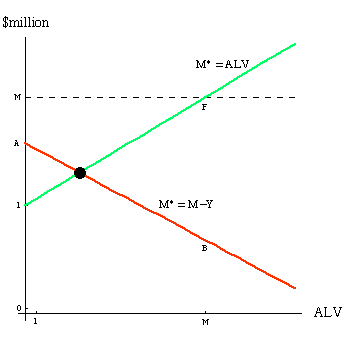
Figure 9 illustrates the equilibrium condition.
Figure 9
In a world without land tax, the market value of the land is M which does not vary with the ALV. In a world with land tax, the tax liability (Y) is an increasing linear function of ALV, as per Figure 3. Note that the area MABF defining the tax liability Y is the same shape as the coloured zone in Figure 3 (upside down). The market value adjusted for the tax regime is M* = M - Y (the red line). At equilibrium, ALV = M*: the 45 degree green line. The equilibrium market price is just the intersection of the two curves. This example is actually based on example 1: 2% real land growth. If the growth rate is higher, the red line shifts left, and its slope becomes steeper, causing the equilibrium market value to fall.
Figure 10
Figure 11
The above analysis treats land as purely an investment good. In reality, land is both a consumption good and an investment good. The consumption component should formally be treated in terms of the demand and supply of housing which is highly complex to model properly, involving price elasticities, income elasticities, wealth effects and so on. It is doubtful such an exercise will yield useful results. The effect of a tax will nevertheless be unambiguous: the consumption value of land will fall, but the fall will be less severe than for the investment component. As such, the equilibrium land values derived above are best thought of as lower-bounds on land values after a land tax is imposed. Nevertheless, there is limited scope for land values to rise significantly above these equilibrium lower-bounds because: (i) higher land values bring with them substantially higher average tax rates, (ii) there exist close substitutes to residential land that are not taxed (Victorian land, Queensland land, NSW apartments (effectively taxed at a much lower rate)), (iii) the consumption component itself is probably not that large. After all, it is precisely because of the tax structure in Australia that residential land has become such a major component of personal saving. It is not surprising then that the volatility of land prices has more in common with other financial assets than with consumption goods.
Without any doubt, the most critical factor determining the impact of land tax on land values will be the Coalition's response. If Coalition policy is to remove the land tax upon election to office, and Labor policy is to re-impose it, then roughly speaking the expected liability of the tax will halve, greatly reducing the impact on equilibrium land values, assuming each political party occupies office for equal time. If Coalition policy is to return tax payments collected by the Carr Government tax to those impacted by it, then land values will not change at all. In essence, the Coalition can make the Labor Tax irrelevant, if it so desires. This raises an interesting lobbying question, since both sides of politics have equal power to change the effective tax rate! In fact, one should be able to impute the market's expectation of the Coalition's response from the actual change to Sydney land prices.
Sydney
people have read our land tax papers since 12 Dec '97.

Equilibrium Land Values
calculated at the 10-year Commonwealth discount rate of 6.2%
before (M) and after (M*) introducing the NSW Land TaxExample 1: 2% real growth

Example 2: zero real growth

V. Coda
This paper calculates the tax liability of the NSW Land Tax in net present value terms. This gives a much clearer representation of 'effective' tax rates. It shows that:
12 Dec 97